Unearthing the Best Shovel for Digging in 2026

Disclosure: The Gardener’s Voice is reader-supported. When you buy through links on this page, we may earn a small commission at no extra cost to you. As an Amazon Associate, we earn from qualifying purchases.

#1 Pick

AMES Pony Forged Round Point Shovel (47" Ash Handle)

Runner-up

Corona All-Steel Round Point Shovel

Best Budget

Fiskars 44" Pro Digging Shovel

#1 Pick

AMES Pony Forged Round Point Shovel (47″ Ash Handle)

Score 10.0 OUT OF 10

#2 Pick

Corona All-Steel Round Point Shovel

Score 10.0 OUT OF 10

#3 Pick

Fiskars 44
Fiskars 44″ Pro Digging Shovel
Score 9.4 OUT OF 10
Root Slayer 22011 Garden Shovel
 
Score 9.2 OUT OF 10
Bond LH015 Mini D-Handle Shovel
 
Score 9.2 OUT OF 10

The search for shovels is not for the fainthearted, especially when you consider how many options are out there. But if your gardening mojo is to blast through those thick roots while digging holes, then you need the best tool under your arm.

Just imagine having a spear-head spade. It makes quick work of compacted soil and lets you dig holes like there’s no tomorrow. Now, add a handle made of fibreglass to that tool and you get a combination of strength and flexibility.

So, if you’re about to choose a new shovel and you’re not going for a round-point with a fiberglass handle, we kindly suggest you reconsider.

Shovels are like shoes; they might not be one-size-fits-all, but there’s always a perfect fit for everyone. Similarly, shovels have their own areas of specialty too. There are some designed exactly for cutting through those thick roots or for digging holes.

Others make pushing aside that heaping pile of dirt and soil feel like a cool breeze on a hot summer day. Getting the best tool for your job could simply mean knowing what task you’ll be tackling most.

Choosing the Best Shovels for Digging

Okay, so let’s get down to earth here – what the heck is a shovel? A shovel is like the multi-tool of the garden world. It’s pretty much Superman when you need to get down and dirty with moving material from one place to another.

So, if you’re working with dirt and soil, a shovel is your secret weapon to get things done right and easy.

Now, see, a cousin of the shovel, the spade, is more like Wolverine – it’s got those sharp edges that make mincemeat out of concrete and other hard surfaces.

Understanding Shovel Types

Some of the most common shovel types are the round-pointed shovel and the square-pointed shovel. Now, the differences between these aren’t as simple as apples and oranges. It’s more like tangerines and oranges. They might seem pretty similar, but their strengths lie in different areas.

The round-pointed shovel is your best bet for digging and excavating. It’s round and sharp edges slice through the earth like a hot knife through butter. Whether there’s compacted soil or roots, this guy’s got your back.

As for the square-pointed shovel, if you’re into moving material around or holding a large pile of dirt and soil, then, my dear friend, you’ve found your match. For tasks like moving and sorting peat, it’s a master. Its broad, flat shape can gather more material with each scoop. Now that’s maximizing your energy! 

Blade Material and Construction

Let’s do some digging, not into dirt, but into what goes into a shovel. A serious role here is played by the blade material and construction. Almost all digging shovels and a garden spade sport steel blades. Yeah, the tough guy that withstands blows on an anvil, steel.

Now steel comes in two types: stamped and forged. Stamped steel blades are strong and rigid, but if you’re looking for something with more muscle and longevity, forged blades are your ticket.

Think of forged blades as being sculpted, hammered into shape from a single piece of steel. Kind of makes you feel like Thor every time you dig, eh? The Bully Tools 14-Gauge Round Point Shovel, for example, brings you exactly that!

Shaft Length and Material

Having talked about the blade, let’s not put the shaft in the shade. The length and material of the shaft play a big part in how your shovel performs. From garden shovels to digging tools, shafts come in all lengths, typically between 44 and 48 inches. But those are generic measurements.

If you really want to dig deep without kneecap scrapes, getting a fitting shaft length is crucial. Gauge it based on your height, your tasks, and even the breadth of the area where you’d be working.

Shaft material is another chapter in the book. Been to a salad bar? While steel is broccoli – hefty, durable and great for heavy-duty applications – Wood falls under the potato category – it’s affordable, but it might not stand up to the big jobs.

Fiberglass, you ask? That’s like the crouton of the salad. It’s lighter than steel or wood, flexible yet sturdy, and rust? It doesn’t want to hear about it!

Handle and Grip

Grips and handles aren’t just a feature. They’re a blessing in disguise when you’ve got long hours of work ahead. Do you know how your aunt’s pudding does not feel right without that secret ingredient?

Well, ergonomically designed grips are just that. They offer a hand grip that provides good traction, lessen your chances of getting blisters, and limit that hand fatigue from coming your way

1. AMES Pony Forged Round Point Shovel (47″ Ash Handle)

Score 10.0 OUT OF 10

The AMES Pony is a classic forged round point shovel for heavy digging. Its 8.75 x 11.5 inch blade is forged from 12-gauge steel and joined to a 47-inch ash wood handle with a solid shank.

Forged blades are heated and hammered into shape rather than stamped from flat sheet steel, which makes them thicker and stiffer. Together with the solid shank, that makes the Pony well suited to prying, breaking up compacted soil, and digging in rocky or root-filled ground. The blade has a turned step, so you can push down with your boot, and a 6-inch blade lift for scooping soil.

The 47-inch ash handle is a little shorter than many long-handle shovels, and its smaller “pony” blade moves less soil per scoop, so it is less tiring for a full day of digging. Ash is strong and absorbs shock well, but wood needs more care than fiberglass. Store it out of the rain and rub the handle with linseed oil now and then to keep it from drying and splintering.

Pros

  • Forged 12-gauge steel blade with a solid shank
  • Turned step for driving the blade with your foot
  • Smaller pony blade is easier to control in tough soil
  • Ash handle absorbs shock

Cons

  • Wood handle needs dry storage and occasional oiling
  • Moves less soil per scoop than a full-size blade

2. Corona All-Steel Round Point Shovel

Score 10.0 OUT OF 10

The Corona All-Steel Round Point Shovel has nothing to do with the beer you enjoy over the weekend. It’s more about digging dirt. Compared to its wooden kin, this all-steel buddy is a towering figure of durability. Yeah, it punches its weight. You’d think it eats steel for breakfast.

However, durability comes with a price tag that might raise an eyebrow or two, but remember the ol’ saying, “You get what you pay for.”

A notable feature about this shovel is the extendable handle. It’s got a sharp blade too; sharper than Granny’s wit. The construction’s so sturdy you’ll swear it’s promised a lifetime warranty.

Pros

  • All-steel construction ensures high durability and robustness.
  • Sharp blade enables efficient digging and cutting through roots. No root can stand its ground.
  • Extendable handle provides flexibility in working across various ground levels.
  • Lifetime warranty – a testament to the product’s quality.

Cons

  • High-end pricing, but well, it’s a bang for your buck.
  • Weight may be an issue if you aren’t used to a bit of heft in your shovel.

3. Fiskars 44″ Pro Digging Shovel

Score 9.4 OUT OF 10
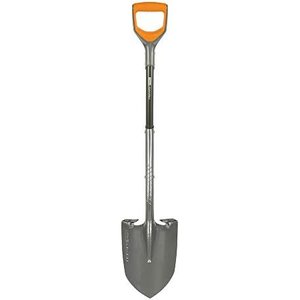
Fiskars 44

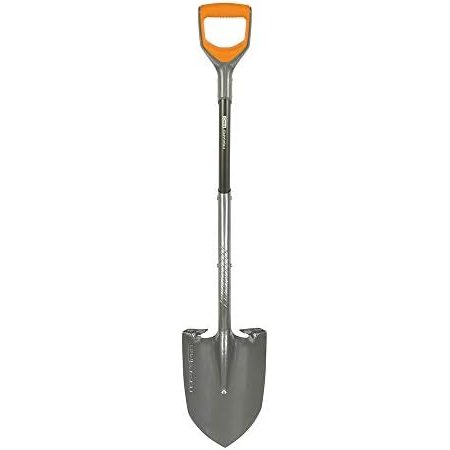
The Fiskars 44″ Pro Digging Shovel has a heavy-gauge steel spade with a sharpened edge that cuts into tough soil and stays sharp through heavy use. An aluminum D-handle and a teardrop-shaped shaft give you two-handed control for digging, prying, and turning soil.

Its 44-inch length is shorter than a full-size round-point shovel, which makes it handy in garden beds and for planting holes. Fiskars covers it with a lifetime warranty.

Pros

  • Sharpened heavy-gauge steel blade
  • Aluminum D-handle for control
  • Compact 44″ length
  • Lifetime warranty

Cons

  • Shorter handle means more bending on big jobs
  • Pricier than basic shovels

4. Root Slayer 22011 Garden Shovel
Score 9.2 OUT OF 10
Root Slayer 22011 Garden Shovel

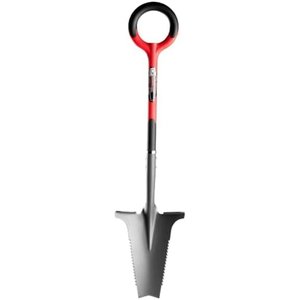
The Root Slayer 22011 is built for digging in root-filled and compacted soil. Its carbon steel blade has serrated edges and a sharpened inverted-V tip that slices through roots and dense ground, with a powder-coated finish to resist rust.

A resin-encased steel shaft and an ergonomic handle help with leverage and control. It is meant for digging, planting, transplanting, and root cutting, not for heavy prying.

Pros

  • Serrated edges and V-tip cut roots
  • Carbon steel blade, powder coated
  • Strong resin-encased steel shaft

Cons

  • Not designed for prying
  • Narrow blade moves less soil per scoop

5. Bond LH015 Mini D-Handle Shovel

Score 9.2 OUT OF 10
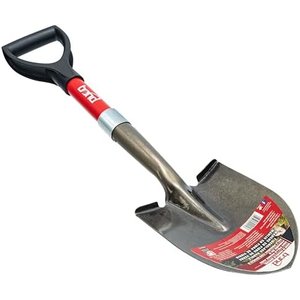
Bond LH015 Mini D-Handle Shovel

The Bond LH015 is a short D-handle shovel for light-duty jobs where a full-length shovel is overkill: planting in tight beds, moving small amounts of soil or mulch, camping, or keeping in the car.

It has a heat-treated head with sharpened edges to help break up tough dirt, a rust-resistant powder-coated finish, and a non-slip grip. Don’t expect it to do the work of a full-size round-point shovel.

Pros

  • Compact and easy to store
  • Heat-treated head, sharpened edges
  • Powder-coated, rust resistant
  • Non-slip grip

Cons

  • Short handle; not for big digging jobs

Frequently Asked Questions

1. What should I look for in a shovel?

Buying a shovel ain’t no Sunday picnic. You gotta keep an open eyeball for the shaft material. Some shovels flaunt steel shafts; strong as an ox but as heavy as a buffalo.

Then there are those with fiberglass handles—lighter but probably break under pressure like a deck of cards. And let’s not forget the ones with steel handles, dependable, but susceptible to rust. The blade too, is important—shovels with blades welded directly to the blade is not unlike a well-done steak—tough and durable.

There are as many opinions on garden spades as there are chickens in a coop. But most folks recommend the Fiskars Garden Spade for garden tasks. Light yet potent enough to tackle roots and stubborn soil. 

Alright, if thick roots are your nemesis, better take a gander at the Bully Tools Round Point Shovel. Its build is stout and blade is sharp, giving more punch than a rowdy barfly. It cuts through the gnarliest of roots like a coonhound on a raccoon’s trail.

Shovel Price Comparison

Shovel prices change often, so instead of listing exact prices, here is where each pick sits and what the extra money buys you:

Price tierShovelTypeWhat you get
BudgetBond LH015 Mini D-HandleShort D-handle, sharpened edgesA light, compact shovel for planting, containers, and tight spots; not built for deep digging
Mid-rangeFiskars 44″ Pro Digging ShovelHeavy-gauge steel spade, D-handleA sharpened blade for tough soil, backed by a lifetime warranty
Mid-rangeRoot Slayer 22011Serrated carbon steel blade, V-shaped tipCuts through roots and compacted ground
PremiumAMES Pony Forged Round Point (47″ ash handle)Forged 12-gauge steel blade, solid shank, ash handleHeavy-duty, long-lasting construction for frequent digging
PremiumCorona All-Steel Round PointAll-steel constructionMaximum strength for heavy digging and prying

If you dig a few times a season, a mid-range shovel with a warranty is the sweet spot. Premium models pay off when you dig often or work in rocky, root-filled ground.

Conclusion

Choosing the right shovel is a bit like picking out a trusty sidekick for your dirt-wrestling adventures. It’s all about knowing the enemy, be it loose dirt, stubborn soil and clay, or those sneaky roots hiding beneath the surface.

You need a weapon that’s up for the challenge, whether you’re digging wide pits or narrow trenches.

We’ve taken a gander at a range of shovel contenders, gauging their merits from the business end of the blade to the top of the handle. A standout being the all-steel Fiskars, with added strength from its 12-gauge steel construction, ready to go a few rounds with the toughest soil.

Despite everything it brings to the match, this shovel weighs lightly on your arm, letting you duke it out with your digging tasks without throwing in the towel. So there you have it, the dirt on the best shovel contenders for 2026.

Leave a Comment