Table of Contents
Sharpen lawn mower blades about every 20 to 25 hours of use, which for many home lawns is about twice a season, according to Ohio State University turf guidance and Oregon State University Extension (citing typical manufacturer recommendations). Virginia Cooperative Extension suggests a slightly more frequent habit: at the start of the season, again in late spring, and once more in mid-to-late summer.
A dull blade tears the grass instead of cutting it. The lawn looks gray or brown at the tips, and the ragged edges dry out faster.
If the lawn looks dull a day after you mow, the blade is often the reason, not the fertilizer. A sharp blade also takes less power, which is easier on the engine. This page covers how often to sharpen, how to tell when you are due, and how to do the job safely. If you drive a zero-turn, pair this with our zero-turn driving guide and our zero turn mower comparison.
How Often Is Often Enough?
Ohio State University’s turf program says blades should typically be sharpened after 25 hours of use, or about two times per season. Oregon State University Extension reports that most mower manufacturers recommend sharpening every 20 to 25 hours of use. Virginia Cooperative Extension turf specialist Mike Goatley recommends at least three sharpenings in a growing season: before the grass takes off, in late spring, and again in mid-to-late summer.
Those numbers assume a normal lawn, not a sandy lot or a yard full of sticks. Hit a rock, a hidden root, or a thick patch of debris, and you should inspect the blade that day. Sandy soil and gravel edges also wear an edge faster. Maryland Extension’s home-lawn guidance is in the same spirit: sharpen at the beginning of the season and then about every 4 to 6 weeks.
Signs the Blade Is Dull
Goatley describes the look clearly: a lawn cut with a dull blade has a brownish-white cast where the torn tips have dried. The cut edge looks shredded, not clean. You may also notice the mower working harder, leaving strips of uncut grass, or wrapping wet clippings around the spindle.
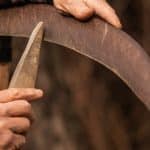
Take the blade off and look at the cutting edge (see safety steps below). A sharp blade has a clean bevel. A dull one is rounded, nicked, or shiny where it has been rolling metal instead of slicing. Deep gouges mean it is time to replace the blade, not just file it.
How to Sharpen a Blade Safely
Work on a cool engine, outdoors or in a well-ventilated area. Disconnect the spark plug wire so the mower cannot start. For battery mowers, remove the battery. Put on safety glasses and gloves. Tip a walk-behind mower so the air filter and carburetor side stay up, following your manual. On a rider or zero-turn, use the deck’s service position if it has one, and chock the wheels.
Virginia Tech’s Extension guidance is that you will need a socket to remove the blade bolt, a vise, a metal file or an angle grinder, and a way to keep the blade from spinning. Note which way the blade faces before you remove it, and keep hardware in order. File or grind the existing bevel; do not try to create a razor-thin knife edge, which chips. Take the same amount of metal off each side of a two-sided blade, then check the balance by hanging the blade on a nail through the center hole. If one side dips, file a little more off that side. An unbalanced blade shakes the spindle and bearings.
1. Crescent Nicholson 8-inch Mill File with Handle
A basic file for a mower-blade bevel
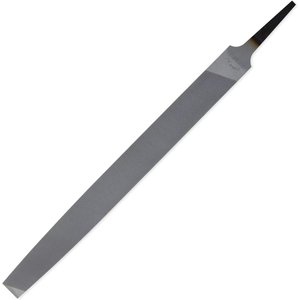
- 8-inch mill single-cut bastard file; this listing includes a handle
- Use it to follow the blade’s existing bevel, then check balance
- Safety glasses and a disconnected spark plug still come first
Virginia Tech Extension lists a metal file as one of the tools for sharpening a blade in a vise. A mill file is the ordinary shop tool for that job. File along the existing bevel, take off a little metal at a time, and balance the blade when you are done. Replace the blade if it is cracked or badly gouged.
Pros
- Standard sharpening tool named in extension guidance
- No power tool required
Cons
- Slower than a bench grinder on a badly nicked blade
- A file will not fix a bent or cracked blade
If you would rather not do this, many hardware stores and mower shops will sharpen or replace a blade for you. Replacing a badly worn blade is often cheaper than ruining a spindle. After you remount the blade, torque the bolt to the figure in your manual, reconnect the spark plug or battery, and keep a second sharp blade on the shelf so you can swap quickly mid-season.
Hand tools need a different motion than a mower blade. For pruners, hoes, and shovels, see how to sharpen garden tools.
Frequently Asked Questions
Can I sharpen the blade without taking it off?
You can touch up some walk-behind blades in place, but it is harder to keep the angle even and almost impossible to balance the blade. Removing it is safer and more accurate.
How do I know I need a new blade instead of a sharpening?
Replace it if it is cracked, badly bent, or so worn that you cannot restore a clean bevel without making the blade much narrower than it started.
Does a mulching blade need sharpening more often?
It still follows the same 20-to-25-hour guidance. Mulching blades have more cutting edges to inspect, and they work harder when you leave clippings on the lawn.
Sources
- Ohio State University, Turfgrass Establishment Series: Mowing
- Oregon State University Extension, Leave grass clippings on the lawn
- Virginia Cooperative Extension / Virginia Tech, Sharpen lawnmower blades
- University of Maryland Extension, Mowing or Grasscycling

I’m Gerry Potratz. I’ve been growing gardens and caring for lawns since the 1950s, and I still prefer to do the work myself. At 85, I write these guides to help home gardeners sort out what’s real and effective from what’s hype, and I lean toward environmentally friendly products.