Table of Contents
Disclosure: The Gardener’s Voice is reader-supported. When you buy through links on this page, we may earn a small commission at no extra cost to you. As an Amazon Associate, we earn from qualifying purchases.
Gardeners often pause in the soil aisle over two bags that look alike: one says potting soil, the other says potting mix. The names sound like two different products, but they are not standardized. Many bags labeled “potting soil” are the same kind of lightweight container blend sold as “potting mix.” The ingredient list tells you more than the words on the front.
Quick answer: potting soil vs potting mix
Potting mix is a soilless blend made for containers — usually sphagnum peat moss or coconut coir, plus bark, perlite or vermiculite, and often compost. Bags labeled “potting soil” are frequently the same kind of container mix; the name is not standardized, so read the ingredients rather than trusting the front of the bag. Neither one is garden soil, which is meant for the ground. For vegetables and herbs in pots, choose a light container mix, ideally one that is OMRI Listed if you want a product reviewed for organic production, and check whether it is peat- or coir-based and how long its fertilizer is meant to feed.
- Best all-purpose organic mix: Black Gold Natural & Organic Potting Mix
- Best rich blend for vegetable containers: Coast of Maine Bar Harbor Blend Potting Soil
- Best peat-free (coir) mix: Coast of Maine Acadia Blend Potting Soil
- Best widely available organic mix: Miracle-Gro Organic Potting Mix
- Best mix labeled for vegetables and herbs: PRO-MIX Premium Organic Vegetable & Herb Mix
Are potting mix and potting soil the same thing?
Sometimes they are. There is no single rule that forces a “potting soil” bag to contain mineral soil, or a “potting mix” bag to be soilless. The products are often sold interchangeably, so the ingredients matter more than the name.
What “potting mix” usually means
Extension guides treat potting mix as a soilless medium made for containers, not as dirt from the garden. The University of Maryland Extension describes commercial soilless mixes as lightweight blends that drain well, typically made of sphagnum peat moss, perlite, vermiculite, composted bark, compost, and coconut coir, plus small amounts of lime and fertilizer. UMass Extension says potting mixes — also called soilless mixes — usually combine peat moss, pine bark, coir, perlite, and vermiculite.
What “potting soil” on a bag often means
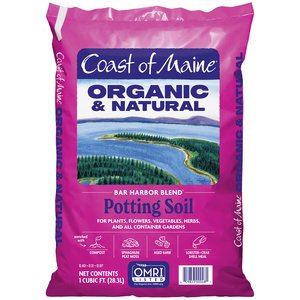
In a garden center, “potting soil” is often the same kind of container mix. Coast of Maine Bar Harbor Blend Potting Soil is a clear example: the bag is named potting soil, and the manufacturer still describes it as a mix for pots, hanging baskets, raised beds, and planter boxes. Turn the bag over and look for peat or coir, bark, perlite or vermiculite, compost, and any fertilizer charge. Do not assume that “soil” on the label means garden dirt.
How this is different from garden soil
Garden soil is meant for the ground. In a pot it can compact, stay wet, and starve roots of air. Maryland Extension notes that garden soils are too dense for containers, and UMass Extension makes the same point about mineral-based soils. If the choice is garden soil versus a potting product, see garden soil vs potting soil. This page stays with potting soil vs potting mix, and with choosing an organic mix for containers.
What to look for on an organic potting mix bag
Three details do most of the work: whether the mix is OMRI Listed, what the base ingredients are, and whether fertilizer is already in the bag.
OMRI Listed vs a generic “organic” claim
OMRI, the Organic Materials Review Institute, lists input products allowed for use in certified organic production under USDA National Organic Program rules. That is not the same thing as a USDA Organic seal on food, and it is not a quality grade or a promise of bigger harvests. The exact product name has to match the listing; other bags in the same brand line may not be listed. If a bag says “natural and organic” but does not point to an OMRI listing for that exact name, treat the wording as a claim and keep reading the ingredients.
Ingredients that belong in a container mix
Look for a base of sphagnum peat moss or coconut coir, then bark or composted bark, and a mineral opener such as perlite, pumice, or vermiculite. Compost is common, and some organic mixes add earthworm castings, kelp, or other meals. Maryland Extension notes that organic soilless mixes omit chemical wetting agents and use organic rather than synthetic fertilizers. UMass Extension adds that organic mixes may use yucca extract as a wetting agent. If the first ingredients look like screened topsoil or a heavy garden blend, the bag may not be the light medium pots need.
Organic fertilizer already in the mix — and when you still need to feed
Many potting mixes include a starter charge of fertilizer. UMass Extension notes that a starter charge is often gone after two or three waterings, while a continuous or slow-release charge lasts longer. Feed windows such as “up to 2 months” or “up to 3 months” are manufacturer claims, not independent tests. When that charge fades, plants still need feeding; see plant food vs fertilizer. Containers also dry out faster than beds, so pots need more frequent watering checks. How often you should water a garden covers the broader timing.
Peat vs coconut coir (and the sustainability tradeoff)
Peat and coconut coir both hold water well. Neither is impact-free, and “better” depends on what you are trying to avoid.
Sphagnum peat moss is still the base of many quality mixes, including several OMRI-listed bags below. University of Illinois Extension notes that peat wetlands take thousands of years to form, with peat accumulating at about 1 millimeter per year, while industry harvesting is described at about 22 centimeters per year. Those wetlands purify water and take up carbon dioxide, and the same article says reclamation after harvest can take up to 20 years to return to pre-harvest functions. Oregon State University soil scientist Linda Brewer notes that harvesting dries the peat, releases carbon, and destroys habitat after bogs have sequestered carbon for thousands of years.
Coconut coir is a byproduct of the coconut industry. Illinois Extension says it holds water and nutrients similarly to peat moss, and UMass Extension notes that coir is easier to re-wet after it dries than peat moss. Illinois Extension also warns that salt content can be high because of processing, though low-salt varieties are available. Brewer describes coir as the closest substitute for peat, but notes the fossil fuel used to transport it. Compost is another alternative, with the caveat that it decomposes faster than peat.
If avoiding peat is the priority, Coast of Maine Acadia Blend is the peat-free, coir-based pick in this group. If you prefer a widely available peat-based organic mix, several other bags below fit that description. Some manufacturers say their peat is “responsibly sourced” or comes from Veriflora-certified peatlands. Those are manufacturer claims, not independent audits reviewed here.
Which mix to buy for vegetables, herbs, and containers
For vegetables in pots, start with a light, OMRI-listed container mix and check the fertilizer story on the bag. Bar Harbor Blend is the richer, compost-and-marine-meal option. PRO-MIX Premium Organic Vegetable & Herb Mix is the bag labeled for vegetables and herbs. Black Gold Natural & Organic Potting Mix is the all-purpose choice. The same mixes work for herbs in pots; soil for herbs in the ground is covered in what is the best soil for an herb garden. For arranging the pots themselves, see how to arrange garden pots.
For seed starting, prefer a lighter seed-starting mix if the bag in your hand is a rich, fertilizer-heavy blend. A “hot” mix can be hard on tender seedlings. This guide does not pick a separate seed-starting product. If you want a peat-free mix, choose Acadia Blend.
Best organic potting mixes compared
These five mixes were chosen as organic, container-ready options. OMRI status for Black Gold, Bar Harbor Blend, and Acadia Blend was confirmed on certificates that listed an Allowed status and a June 1, 2027 expiration when they were checked in November 2026. Miracle-Gro and PRO-MIX are described as OMRI Listed on their manufacturer pages. Prices and ratings are left off on purpose; use the links to check a current listing.
| Mix | Best for | Base | OMRI status | Fertilizer / feed window | Main tradeoff |
|---|---|---|---|---|---|
| Black Gold Natural & Organic Potting Mix | All-purpose containers, including vegetables and herbs | Peat, bark, compost, perlite, pumice or cinders | OMRI Listed (certificate, Allowed) | Organic fertilizer and earthworm castings | Not peat-free |
| Coast of Maine Bar Harbor Blend Potting Soil | A richer blend for vegetable and herb containers | Peat, composted manure, aged bark, perlite | OMRI Listed (certificate, Allowed) | 0.4-0.11-0.07 from kelp, lobster, and crab shell meal | Not peat-free or vegan; named “potting soil,” but made for containers |
| Coast of Maine Acadia Blend Potting Soil | Peat-free, vegan container growing | Coir, aged bark, compost, wood biochar | OMRI Listed (certificate, Allowed) | 0.4-0.1-0.2 from compost, alfalfa meal, and kelp | Coir can hold salt if it is not well processed |
| Miracle-Gro Organic Potting Mix | A widely available organic container mix | Peat, compost, naturally derived nutrients | Manufacturer states OMRI Listed | 0.09-0.06-0.06; poultry-litter fertilizer the company says feeds for up to 2 months | Not peat-free or vegan; recipe can vary by region |
| PRO-MIX Premium Organic Vegetable & Herb Mix | A mix labeled for vegetables, fruit, and herbs | 60–75% Canadian sphagnum peat moss | Manufacturer states OMRI Listed | Organic fertilizer the company says feeds for up to 3 months; mycorrhizae | Not peat-free; also sold for in-ground use |
Best all-purpose organic mix
Black Gold Natural & Organic Potting Mix is the all-purpose pick. Sun Gro describes it for containers and raised beds, including vegetables and herbs, houseplants, and indoor and outdoor containers. It contains earthworm castings and an organic wetting agent, and the manufacturer lists sizes from 8 quart to 2.0 cubic foot. The OMRI certificate names it “Sun Gro Black Gold Natural & Organic Potting Mix Plus Fertilizer Resilience Silicon Enriched 0.09-0.03-0.03,” status Allowed, listed April 27, 2021, with a June 1, 2027 expiration on the certificate checked in November 2026.
Who it is for: Gardeners who want one OMRI-listed bag for a wide range of pots, including vegetables and herbs.
Limitation: It is not peat-free. Some ingredients, including compost and pumice or cinders, can vary.
Best rich blend for vegetable containers
Coast of Maine Bar Harbor Blend Potting Soil is the richer blend for vegetable and herb containers. The manufacturer labels it for plants, flowers, vegetables, herbs, and container gardens, including pots, hanging baskets, raised beds, and planter boxes. The guaranteed analysis is 0.4-0.11-0.07, derived from kelp meal and lobster and crab shell meal, with 0.4% slowly available nitrogen from those sources. The OMRI listing name is “Coast of Maine Organic & Natural Bar Harbor Blend Potting Soil,” status Allowed, listed October 5, 2021, with a June 1, 2027 expiration on the certificate checked in November 2026. The bag is named “potting soil” and is still a container mix.
Who it is for: Gardeners potting vegetables, herbs, or flowers who want a compost-and-marine-meal blend with an OMRI listing.
Limitation: It is peat-based and includes composted manure and marine meals, so it is not a vegan or peat-free mix.
Best peat-free organic mix
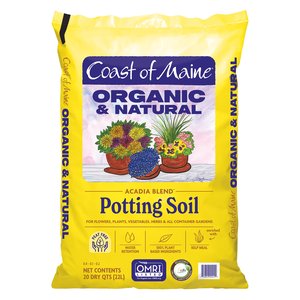
Coast of Maine Acadia Blend Potting Soil is the peat-free pick. The manufacturer describes it as 100% vegan and peat-free, with no peat moss or animal manures, for flowers, vegetables, and herbs in pots, hanging baskets, raised beds, and planter boxes. The guaranteed analysis is 0.4-0.1-0.2, derived from compost, alfalfa meal, and kelp, with 0.4% slowly available nitrogen from those sources. The OMRI listing name is “Coast of Maine Organic & Natural Acadia Blend Potting Soil,” status Allowed, listed July 14, 2025, with a June 1, 2027 expiration on the certificate checked in November 2026.
Who it is for: Gardeners who want an OMRI-listed, peat-free, plant-based mix for vegetables, herbs, and flowers in containers.
Limitation: Coir can hold salt if it is not well processed — a general caution from extension sources, not a lab result on this bag. Availability can also be narrower than a big-box mix.
Best widely available organic mix
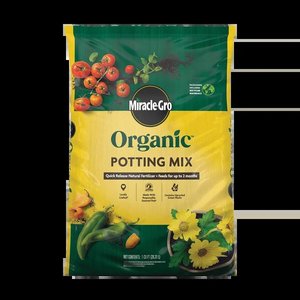
Miracle-Gro Organic Potting Mix is the widely available organic option, sold as SKU 78951430 in a 1 cubic foot bag on the manufacturer’s site. The company states that the mix is OMRI Listed and “meets the guidelines for use in organic container gardening.” It is described as a blend with compost, sphagnum peat moss, and naturally derived nutrients, for indoor and outdoor container plants, including vegetables, fruits, flowers, and herbs. The fertilizer analysis is 0.09-0.06-0.06. The company says a natural fertilizer derived from poultry litter feeds for up to 2 months, and that one 1 cubic foot bag fills approximately three 10-inch containers. The peat is described as coming from Veriflora-certified peatlands, and the mix as regionally formulated, so the recipe can vary; those are manufacturer claims.
Look for the exact name Miracle-Gro Organic Potting Mix (sometimes written Organic™ Potting Mix) and SKU 78951430 when you can find it. Do not confuse it with Organic Choice, Nature’s Care, Moisture Control, Miracle-Gro Organic Outdoor Potting Mix, or the regular Miracle-Gro Potting Mix advertised as feeding for up to 6 months. A matching Amazon listing for this exact SKU was not confirmed when this guide was written, so check current packaging at a retailer.
Who it is for: Gardeners who want a widely sold organic container mix and are comfortable with a peat-based, poultry-litter-fed blend.
Limitation: It is not peat-free or vegan; ingredient details can vary by region.
Best organic mix labeled for vegetables and herbs
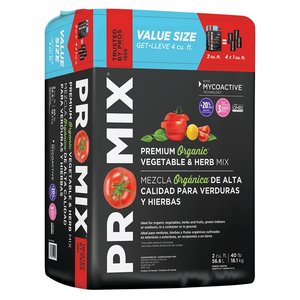
PRO-MIX Premium Organic Vegetable & Herb Mix is the bag written for edible plants. The manufacturer describes it as OMRI Listed for use in organic gardening, peat-based, and ready to use for vegetable, fruit, and herb gardens, in the ground or in containers. It includes MYCOACTIVE mycorrhizae (PTB297 Technology) and, according to the company, organic fertilizer that gradually feeds plants for up to 3 months. Listed ingredients are Canadian sphagnum peat moss (60–75%), peat humus, compost, perlite, gypsum, limestone for pH adjustment, organic fertilizer, and mycorrhizae. Premier Tech states that its peat moss comes from bogs certified under the Veriflora Program, which is a manufacturer claim. Sizes listed include 1 cubic foot and 2 cubic foot bags. For in-ground vegetable soil, see the best organic soil for a vegetable garden.
Who it is for: Gardeners who want a mix explicitly labeled for vegetables and herbs and who do not need a peat-free bag.
Limitation: It is 60–75% sphagnum peat moss, so it is not the peat-free choice.
When you still need garden soil instead
A potting mix is for pots, hanging baskets, window boxes, and other containers. It is not the default fill for an in-ground bed, and it is usually not the best sole ingredient for filling an entire raised bed. Some of the bags above are also labeled for raised beds by the manufacturer. That is a label fact, not an instruction to fill a whole bed with bagged potting mix.
For in-ground vegetable soil, start with the best organic soil for a vegetable garden and how to prepare garden soil for next year. If you are choosing between garden soil and a potting product, go back to garden soil vs potting soil. Mulch belongs on beds as a surface layer, not as a stand-in for potting mix; see the best vegetable garden mulch. Maryland Extension says topsoil should only be added to very large containers and should not exceed 10% of the volume.
Frequently asked questions
Is potting mix the same as potting soil?
Often, yes. Many bags with either name are soilless container mixes. The names are not standardized, so read the ingredients.
What is the difference between potting soil and potting mix?
In extension guides, potting mix is a soilless blend of peat or coir, bark, perlite or vermiculite, and often compost, made for containers. In stores, “potting soil” is frequently used for the same kind of mix. Watch whether the bag is a light container medium or a heavy soil meant for the ground.
Can I use potting mix for vegetables and herbs in containers?
Yes. A light container mix is the right starting point. If you want a product reviewed for organic production, look for an OMRI Listed bag and check whether fertilizer is already included.
What does OMRI Listed mean on a bag of potting mix?
It means the Organic Materials Review Institute has listed that exact product as allowed for use in certified organic production under USDA National Organic Program rules. It is not a USDA Organic food seal or a score for how well plants will grow. The name on the bag should match the listing.
Does potting mix already contain fertilizer?
Many mixes include some fertilizer, but not all charges last the same amount of time. UMass Extension notes that a starter charge is often gone after two or three waterings, while a slow-release charge lasts longer. Treat published feed windows as company claims.
Is a peat-free (coir) potting mix better?
It is better if your goal is to avoid peat. Coir holds water in a similar way and is often easier to re-wet after it dries, but it can be salty if it is not well processed and is often shipped long distances. Harvesting peat raises carbon-storage and wetland-habitat concerns. Neither base is impact-free. If avoiding peat is the priority, use a peat-free mix such as Coast of Maine Acadia Blend.
Can I use garden soil in pots instead?
Not as the main ingredient. Garden soil is too dense for containers and can compact and stay wet. Maryland Extension and UMass Extension both advise against using it as a potting medium. See garden soil vs potting soil.
Can I fill a raised bed with potting mix?
Usually not as the only fill. Potting mix is made for containers, and filling a whole bed with it is rarely the best use. Some bags are also labeled for raised beds; that does not make bagged potting mix the default way to fill a bed. See garden soil vs potting soil and the best organic soil for a vegetable garden.
What’s the best organic potting mix for vegetables?
There is not one bag that fits every pot. Bar Harbor Blend is the richer compost-and-marine-meal option. PRO-MIX Premium Organic Vegetable & Herb Mix is the bag written for vegetables and herbs. Black Gold is the all-purpose OMRI-listed choice, and Acadia Blend is the peat-free option.
Is potting mix good for starting seeds?
A light seed-starting mix is the better default, especially if the potting mix is a rich blend with a strong fertilizer charge. A “hot” mix can be hard on seedlings. This guide does not recommend a specific seed-starting product.
Related soil and container guides
- Garden soil vs potting soil
- Best organic soil for a vegetable garden
- What is the best soil for an herb garden
- How to arrange garden pots
- Plant food vs fertilizer
- How to prepare garden soil for next year
- When to add manure to a vegetable garden
- Best worms for a garden
- How often you should water a garden
- Best vegetable garden mulch
Sources, checked November 24, 2026: University of Maryland Extension, Growing Media (Potting Soil) for Containers; UMass Extension, Bagged Potting Mixes and Garden Soils for Home Gardeners; University of Illinois Extension, Save wetlands, use soilless potting mixtures; Oregon State University, Harvesting peat moss contributes to climate change, Oregon State scientist says; manufacturer pages for Black Gold Natural & Organic Potting Mix, Coast of Maine Bar Harbor Blend, Coast of Maine Acadia Blend, Miracle-Gro Organic Potting Mix, and PRO-MIX Premium Organic Vegetable & Herb Mix; OMRI certificates for Black Gold, Bar Harbor Blend, and Acadia Blend.
I’m Gerry Potratz. I’ve been growing gardens and caring for lawns since the 1950s, and I still prefer to do the work myself. I write these guides to help home gardeners sort out what’s real and effective from what’s hype, and I lean toward environmentally friendly products.