Table of Contents
Updated November 2026. As an Amazon Associate we earn from qualifying purchases.
This guide is based on manufacturer specifications and published sources, not a hands-on test of every system in our garden. Where a figure comes from a company, we say so.
Quick Answer: The Best Indoor Gardens by Use
The “best” indoor garden depends on how much space you have and how much you want to harvest. For most first-time buyers, the AeroGarden Harvest is the simplest true hydroponic starter: six plants, a 20-watt light, and a small 10.5-by-6-inch footprint. If you want more than a handful of herbs, the LetPot LPH-SE gives you 12 sites and a light arm that extends up to 30 inches.
For a family-sized indoor harvest, the Gardyn Home 4 is the standout: 30 plants in two square feet, with a published energy use of 47 kilowatt-hours a month. The Click & Grow Smart Garden 9 is the easiest low-maintenance option, but it is a Smart Soil wick system, not a hydroponic nutrient tank. We include it because many shoppers compare the two side by side.
If you are still learning how these machines work, start with our indoor hydroponic gardens guide. It covers the growing methods, what to plant, and how to estimate the power bill. This page is the buying comparison.
Product buttons go to Amazon so you can see the current price. Official hardware prices we checked on November 16, 2026, are noted in the text where they help you compare tiers.
How These Picks Were Compared
We compared published specifications: plant count, footprint, light wattage, tank size, energy use, and how each system delivers water and nutrients. Each Amazon ASIN on this page resolved to the correct in-stock model on November 16, 2026. This is not a grow test, so there are no made-up scores.
Two distinctions matter more than brand names. First, some units are hydroponic (roots in, or regularly wetted by, a nutrient solution). Others, including Click & Grow, water a soil-like pod with a wick. Second, some units sit on a counter with a low hood, while vertical towers use floor space and can hold many more plants.
| System | Plants | Type | Light | Footprint / height | Best for |
|---|---|---|---|---|---|
| AeroGarden Harvest | 6 | Hydroponic countertop | 20W LED | 10.5″ × 6″, 17.4″ tall | First garden, herbs |
| AeroGarden Bounty Elite | 9 | Hydroponic countertop | 50W adjustable LED | Taller deck, 24″ grow height on the Bounty family | Taller greens, more light |
| LetPot LPH-SE | 12 | Hydroponic countertop | 24W LED, up to 30″ arm | 16″ × 7″ body | More plants without a tower |
| Click & Grow Smart Garden 9 | 9 | Smart Soil wick | 13W (6.2 kWh/mo) | 23.6″ × 7.5″, 15.8″ tall | Quiet, low-effort herbs |
| Gardyn Home 4 | 30 | Indoor hydroponic tower | 2 × 40W (47 kWh/mo) | 24″ × 12″, 64″ tall | Family harvests in a small floor footprint |
Lettuce Grow’s Original Farmstand is a strong vertical alternative if you also want to grow outdoors, but it is sold on the company’s site rather than as a standard Amazon kit, so it does not get a product box here. See Gardyn vs. Lettuce Grow for that comparison.
The Best Hydroponic Indoor Gardens, Compared
1. Gardyn Home 4
Best for a family-size indoor harvest
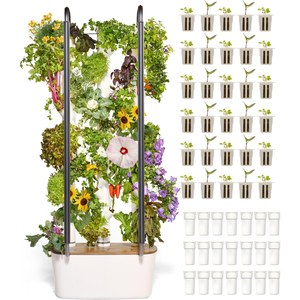
- Plant sites: 30
- Size: 24″ W × 12″ D × 64″ H (2 sq. ft.)
- Lights / energy: Two 40W LED bars; 47 kWh/month, per Gardyn
- Tank: 5 gallons (Gardyn help center)
- Smart features: Two 5MP cameras, sensors, Kelby app assistant (full features with membership)
If the goal is a serious indoor salad supply, plant count and footprint matter more than a pretty countertop hood. The Home 4 puts 30 sites in two square feet and stands a little over five feet tall. Gardyn’s official price, checked November 16, 2026, is $899, and Amazon lists the same Home 4, sold by Gardyn Home.
Gardyn estimates 8 to 10 pounds of produce a month, depending on what you grow, and 47 kilowatt-hours of electricity. At the U.S. residential average of 18.19 cents per kilowatt-hour (EIA, 2026 year-to-date through August), that power use is about $8.55 a month. The bigger ongoing question is membership: $39 a month on the month-to-month Home plan for 10 plant credits and Kelby’s coaching, or you can run the device without it and buy yCubes yourself. Full details are in our Gardyn review and Is a Gardyn worth it?.
Pros
- Far more plants than a countertop unit in a small floor footprint
- Published monthly energy figure
- Can be used without a membership
Cons
- $899 hardware plus optional membership
- Needs 64 inches of height and 2.4 GHz Wi-Fi
- Indoor use only
2. AeroGarden Harvest
Best compact hydroponic starter
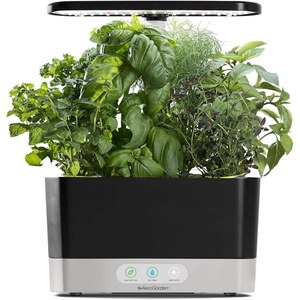
- Plant sites: 6, up to 12 inches tall
- Size / weight: 10.5″ L × 6″ W × 17.4″ H; 5.2 lb
- Lights: 20W full-spectrum LED with automatic timer
- Included: Seed pod kit, 3 oz plant food, power adapter
The Harvest is the model we would point a curious cook toward first. It is inexpensive compared with a tower, it is a genuine hydroponic water-bowl system, and it does not require an app or a subscription. AeroGarden’s listing describes a touch-sensitive panel that reminds you to add water and plant food.
Its limits are honest and visible: six openings and a 12-inch grow height. That is plenty for basil, cilantro, chives, and loose-leaf lettuce if you harvest often. It is not the right machine for a compact tomato. If you later want more light and height in the same brand family, the Bounty Elite is the step up.
Pros
- Small, simple, and hydroponic
- No app or membership required
- Easy way to test whether you will use an indoor garden
Cons
- Only six plants
- 12-inch height cap
- Tank and roots need regular cleaning
3. AeroGarden Bounty Elite
Best taller countertop hydroponic garden
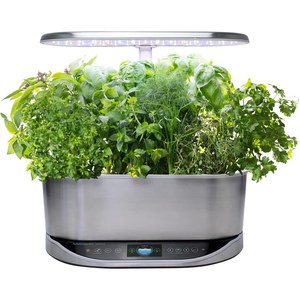
- Plant sites: 9
- Lights: 50W adjustable full-spectrum LED
- Controls: Digital touchscreen, automatic timer, water and plant-food reminders
- Connected features: Wi-Fi, Alexa, AeroGarden app, vacation mode
- Build: Stainless steel, larger water bowl and grow deck than the Harvest
The Bounty Elite keeps the AeroGarden hydroponic method but adds the light and height that fruiting plants need. Official AeroGarden material lists the Bounty Elite at 50 watts, compared with 40 watts for the standard Bounty and 30 watts for the Bounty Basic, and the Bounty family is the line with up to 24 inches of grow height. The Elite listing also adds vacation mode, dimming, and app or Alexa control.
Choose this over the Harvest if you already know you want nine plants and a stronger lamp, and you do not mind a larger deck on the counter. Choose a tower instead if nine plants still feels small.
Pros
- 50W adjustable light and nine pods
- Vacation mode and app or Alexa control
- More grow height than the Harvest
Cons
- Larger and more expensive than the Harvest
- Still a countertop capacity, not a 30-plant tower
- Wi-Fi features are extra complexity if you only want basil
4. LetPot LPH-SE 12-Pod
Best mid-size countertop system
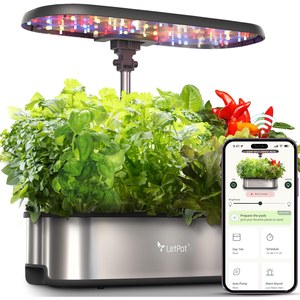
- Plant sites: 12
- Lights: 24W LED, arm adjustable up to 30 inches
- Tank: 5.5 liters
- Controls: LetPot app and Wi-Fi
- Size / weight: 16″ × 7″ × 9.8″ body; 5.41 lb, per LetPot
The LPH-SE fills the gap between a six-pod mini garden and a floor-standing tower. Twelve sites are enough for a mix of lettuces and herbs, and the 30-inch light arm is a real advantage over a fixed low hood. LetPot’s app can set a custom light schedule, including a specific on and off time rather than a single fixed cycle.
It is still a pumped hydroponic box: you add nutrients, you refill the 5.5-liter tank (LetPot says it can last up to three weeks), and you will clean the reservoir. If you want that workflow without paying tower prices, this is the most practical Amazon-available step up from a Harvest.
Pros
- 12 plants and a tall light arm
- Custom light schedules in the app
- Larger tank than most six-pod units
Cons
- App features need Wi-Fi
- Uses the brand’s cups and sponges
- Not a set-in-the-corner vertical tower
5. Click & Grow Smart Garden 9
Easiest low-maintenance indoor garden
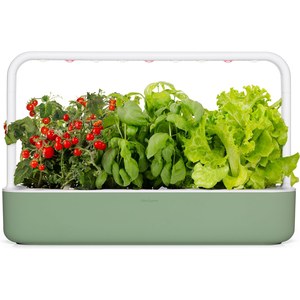
- Plant sites: 9
- Lights / energy: 13W; 6.2 kWh/month, per Click & Grow
- Tank: 4 liters (1.06 gal); company water use up to 6 liters a month
- Size / weight: 23.6″ × 7.5″ × 15.8″ with one extension; 5.3 lb
- Method: Smart Soil pods with a wick; no liquid fertilizer in the tank
We include the Smart Garden 9 because it is the system many people land on when they search for a hydroponic garden, even though Click & Grow is explicit that it is not one. The pods contain Smart Soil. A wick pulls water from the tank. There is no pump noise and no weekly nutrient dose. Official specifications also make the running cost easy to estimate: 6.2 kilowatt-hours a month is about $1.13 at the EIA average rate.
The tradeoff is control and crop size. You are buying into a pod catalog, individual plants stay in their cups, and this is not the machine for a dense, high-yield salad tower. It is a very good machine for a quiet windowsill of basil, lettuce, and herbs. The Amazon listing we verified (green, ASIN B0HHN83RS4) is sold by Click and Grow (Official) and was in stock on November 16, 2026. For a full comparison with AeroGarden, see AeroGarden vs. Click & Grow.
Pros
- Silent wick watering and no tank fertilizer to mix
- Very low published energy use
- Easy to replace one plant at a time
Cons
- Not a hydroponic nutrient system
- Tied to Click & Grow pods for best results
- Nine compact plants, not a family-size harvest
Which System Should You Buy?
You want fresh herbs and a little lettuce with almost no learning curve
Choose the Harvest if you want a true hydroponic starter, or the Smart Garden 9 if you want the quietest, lowest-touch option and are fine buying that brand’s pods. Either one will teach you whether you actually harvest what you grow. That is the question that matters more than a 30-plant brochure.
You cook a lot of greens and still want a countertop unit
The LetPot LPH-SE is the more sensible mid-size pick than jumping straight to a 5-foot tower. Twelve sites and a 30-inch arm give you room to keep a rotation of lettuce going. The Bounty Elite is the better pick if you already like AeroGarden pods and want a stronger, taller light for compact fruiting plants.
You want a family-size indoor harvest in a small floor space
The Gardyn Home 4 is the one that actually changes how much you can grow indoors. Read the cost breakdown before you buy, because membership and plant credits shape the yearly bill as much as the $899 hardware price. If you have a patio with sun and might move the garden outdoors, look at Lettuce Grow before you commit to an indoor-only tower.
What we would not do
We would not buy a six-pod unit expecting it to replace grocery salads for a family, and we would not buy a 30-plant tower for a single basil plant. We would also not treat a Click & Grow and an AeroGarden as the same kind of machine. One waters Smart Soil with a wick. The other grows roots in a nutrient solution. Both can work well; they just ask different things of you.
What to Budget After You Buy
Electricity is predictable once you know the wattage or the manufacturer’s monthly figure. Using the EIA average of 18.19 cents per kilowatt-hour (2026 year-to-date through August):
- Click & Grow Smart Garden 9, 6.2 kWh/month: about $1.13.
- Gardyn Home 4, 47 kWh/month: about $8.55.
- A 20-watt lamp running 15 hours a day: about 9 kWh, or $1.64, as a worked example when a monthly figure is not published.
- A 50-watt lamp on the same 15-hour example: about 22.5 kWh, or $4.09.
Pods, yCubes, live seedlings, and liquid nutrients are the variable. They are also the part of the hobby that can cost more than power. Plan for them the same way you plan for coffee pods or filter replacements: if the brand’s refills feel expensive, look now at whether the system accepts generic sponges or your own seeds.
Frequently Asked Questions
What is the best hydroponic indoor garden for beginners?
The AeroGarden Harvest is the most straightforward hydroponic starter: six plants, a 20-watt light, and no app or membership. If you would rather not mix liquid nutrients at all, the Click & Grow Smart Garden 9 is easier, but it is a Smart Soil wick system rather than a hydroponic tank.
Is a vertical tower worth it over a countertop garden?
It is if you will plant most of the openings and you have the floor space and height. A Gardyn Home 4 holds 30 plants in two square feet, which a six-pod unit cannot match. It is not worth it if you only want a few herbs, because you will pay tower money and still have to maintain a large tank.
Are Click & Grow gardens hydroponic?
No. Click & Grow says its Smart Gardens use capillary precision irrigation and Smart Soil, with a wick drawing water from the tank. Nutrients are in the pod, not mixed into the reservoir. That is why the company markets the system as easier than hydroponics.
Do I need Wi-Fi for an indoor garden?
Not for the basic Harvest. You do need a 2.4 GHz network for a Gardyn if you want the app and cameras, and you need Wi-Fi for LetPot’s app scheduling and for the Bounty Elite’s app and Alexa features. The plants will still grow if a connected feature is turned off, but you lose those reminders and automations.
Which system grows the most food?
By plant count and the company’s own yield estimate, the Gardyn Home 4 is in a different class: 30 sites and a claimed 8 to 10 pounds a month, depending on the crop. A countertop unit is built for herbs and a modest bowl of greens, not a family salad supply.
Related Guides
- Indoor Hydroponic Gardens: How They Work and How to Choose
- Gardyn Home 4 Review
- Is a Gardyn Worth It?
- Gardyn vs. Lettuce Grow
- AeroGarden vs. Click & Grow
The Gardener’s Voice Team publishes practical gardening guides and product comparisons for home gardeners. We explain how tools, soil, watering systems, and lawn equipment work, and we show our sources when we cite a figure or a recommendation.