Table of Contents
Updated November 2026. As an Amazon Associate we earn from qualifying purchases.
This guide is based on manufacturer specifications and published sources, not a hands-on test of every system in our garden. Where a figure comes from a company, we say so.
Quick Answer: When a Gardyn Is Worth the Money
The Gardyn Home 4 is worth a close look if you will plant most of its 30 sites and you already spend real money on salad greens and herbs. The hardware is $899 on mygardyn.com (checked November 16, 2026). Gardyn estimates 47 kilowatt-hours of electricity a month, which is about $8.55 at the U.S. average residential rate of 18.19 cents per kilowatt-hour (EIA, 2026 year-to-date through August). Month-to-month Home membership is $39 and includes 10 plant credits.
It is harder to justify if you only want a few herbs, if you will leave most openings empty, or if a $39 monthly plan plus almost $900 up front feels like a lot to “try.” In those cases, a compact hydroponic garden or the smaller Gardyn Studio ($549, 16 plants, $25 membership) is the more proportional purchase. Membership is optional; the device still waters and lights plants without it.
This page is a cost analysis, not a second product review. For specs, setup, and cleaning, see our Gardyn Home 4 review. For a tower that can also live outdoors, see Gardyn vs. Lettuce Grow. For how indoor systems work in general, start at the indoor hydroponic gardens hub.
The Up-Front Cost
Gardyn’s official price for the Home 4 is $899. The same model appears on Amazon, sold by Gardyn Home, at the same $899 figure on the day we checked. A smaller Studio 2 is $549. Both include a starter set of plants (30 cubes for Home, 16 for Studio) and plant food. Gardyn also advertises a 3-year warranty on the Home product page and a 100% sprout guarantee if a yCube has not sprouted after 28 days.
That is a different category of purchase from a six-pod countertop garden. You are paying for a 64-inch appliance that holds 30 plants in two square feet, not for a herb kit. If the height, the look, or the plant count is more than you need, no amount of produce math will make the hardware feel small.
Occasionally a retailer or a seasonal promotion will undercut the official number. Gardyn also advertises a price-match promise on its product page. Check the current Amazon price with the button below rather than treating $899 as permanent.
1. Gardyn Home 4
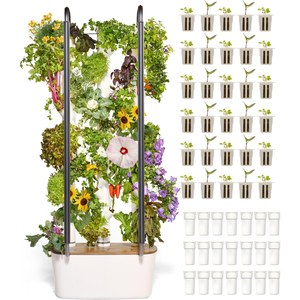
The hardware in this cost analysis
- Official price: $899, checked November 16, 2026, on mygardyn.com and Amazon
- Plant sites: 30
- Energy estimate: 47 kWh/month, per Gardyn
- Membership: Optional; $39/month month-to-month for Home, 10 plant credits
- Warranty: 3 years, per the official product page
The box gets you the tower, lights, starter plants, and plant food. It does not include an ongoing supply of yCubes. Those come from membership credits, prepaid plans, or a la carte purchases.
Pros
- High plant count for the floor space
- Energy use is published, so the power bill is easy to estimate
- Can be run without a subscription
Cons
- High purchase price
- Plant costs add up if you skip membership and buy cubes at $4.99 plus shipping
- You need to use most of the 30 sites for the value to show up in the kitchen
Electricity: A Predictable, Modest Line Item
Gardyn publishes 47 kilowatt-hours a month for the Home and 26 kilowatt-hours a month for the Studio. Those are company estimates, but they are more useful than a bare wattage figure because they already include how the system runs, not just the lamp rating (two 40-watt bars on the Home, one 52-watt bar on the Studio).
The U.S. Energy Information Administration’s Electric Power Monthly, with data through August 2026, lists an average residential price of 18.19 cents per kilowatt-hour for 2026 year-to-date (preliminary). Using that national average:
- Home 4: 47 kWh × $0.1819 ≈ $8.55 per month, or about $103 a year.
- Studio 2: 26 kWh × $0.1819 ≈ $4.73 per month, or about $57 a year.
If your utility charges 25 cents per kilowatt-hour, the Home figure rises to about $11.75 a month. If you pay 14 cents, it falls to about $6.58. The number on your bill is the one that counts; the EIA average is a national benchmark, not a prediction for every state.
Gardyn also compares Home electricity use to “a stand-alone tower fan” and says Kelby can optimize lighting and watering. We cannot verify that comparison, but even at the national average, power is not the expensive part of owning this machine.
Membership and Plant Costs
This is where the yearly bill is decided. Gardyn’s membership page and Home product FAQ, checked November 16, 2026, lay out the following:
| Plan | Price | Plant credits | Notes |
|---|---|---|---|
| Home, month-to-month | $39/month | 10 / month | 30-day trial available in the app, then auto-renews |
| Home, 1-year prepaid | $34/month | 10 / month | Listed on the Home product page |
| Home, 2-year prepaid | $29/month | 10 / month | Listed as the best-value Home prepaid plan |
| Studio, month-to-month | $25/month | 5 / month | Same trial structure |
| No membership, a la carte | yCubes from $4.99 each + $9.99 shipping | None | Member price starts at $1.99 or 1 credit |
Members also get free shipping on those credits, 60% off additional plants, and Kelby’s paid-tier features (camera coaching, vacation mode, Ask Kelby). Credits roll over, up to 30 on a Home and 16 on a Studio. You can cancel auto-renewal in the app.
A simple way to see the membership value is to price the credits at the non-member rate. Ten plants at $4.99 would be $49.90, plus $9.99 shipping if you ordered them as a single shipment, or $59.89. The $39 plan also includes shipping and the app features, so the arithmetic favors membership if you would have bought about 10 cubes a month anyway. If you would only replace a few plants a month, a la carte can be cheaper — until shipping is added to small orders.
Prepaid plans lower the monthly rate if you are sure you will keep the garden for a year or two. They are a weaker deal if you are still deciding whether the habit will stick. There is no need to prepay during the 30-day trial just to “start saving.”
What About the Harvest? The Yield Claim, Used Carefully
Gardyn says a Home can produce 8 to 10 pounds of fresh produce a month, depending on what you grow, and that the Studio can produce up to 5 pounds. Lettuces can be harvested more than once over about four weeks, and herbs can stay harvest-ready for up to 12 weeks, according to the same product page. Members, the company says, harvest 30% more on average.
Those are manufacturer figures. They are useful for scale — this is meant to be a serious greens supply, not a three-pod windowsill — but they are not a weighed result from our kitchen. Actual output will be lower if you leave sites empty, grow mostly slow herbs, or let plants bolt. It will also vary with room temperature and how often you harvest.
We are not going to invent a grocery price per pound and declare a payback month. Lettuce, basil, and specialty greens do not all cost the same, and they do not cost the same in every city. A fairer test is personal: add the hardware (spread over the years you expect to keep it), the power bill, and either $39 a month or your likely a la carte plant spend. Compare that with what you already spend on the same herbs and greens. If you barely buy those items now, a Gardyn will not “pay for itself” in grocery savings. It might still be worth it as a hobby and a source of very fresh leaves. Those are different justifications, and it helps to pick one.
A Realistic Monthly Picture
Here is a conservative way to think about a Home 4 after you have paid for the hardware, using official and calculated figures only:
- Electricity: about $8.55 a month at the EIA average rate, or more if your utility is above 18.19 cents per kWh.
- Membership: $0 if you opt out, $39 month-to-month, or $29–$34 if you prepay for a year or two.
- Extra plants and supplies: $0 in a month when 10 credits cover what you need; more if you buy beyond the credits or purchase HydroBoost and citric acid for cleaning.
- Water: small. Gardyn estimates Home use at about five to six dishwasher loads a month and “around 95% less than traditional gardening,” which is the company’s comparison.
On a membership plan, most owners should think in terms of roughly $40 to $50 a month in visible recurring costs at average electricity rates, not including the amortized $899 hardware. Without membership, the monthly figure can be lower or higher depending on how often you reorder cubes and pay shipping. Neither path is “set and forget” free food.
When It Is Worth It — and When It Is Not
It is a better fit if
- You eat a lot of lettuce, herbs, and leafy greens, and you will plant most of the 30 sites.
- You want an indoor-only tower and do not have (or want) a patio system.
- You are willing to either keep a membership or budget for a la carte yCubes.
- You have 64 inches of height, a 2.4 GHz network, and a place you can strap the unit to the wall.
It is a weaker fit if
- You really want a few basil plants. A Harvest, a Click & Grow Smart Garden 9, or a 12-pod LetPot will do that job for much less money.
- You are buying the 8–10 pound claim as a guaranteed grocery replacement. That number is Gardyn’s estimate and depends on the crop.
- You dislike subscriptions and also dislike $4.99 plants plus shipping. The hardware works without membership, but the plant pipeline gets expensive if you ignore both paths.
- You want a garden that can roll onto a sunny patio. That is Lettuce Grow’s territory, not Gardyn’s.
The Studio is the in-between answer: 16 plants, $549, 26 kWh a month, and a $25 membership. It is the better “I think I’ll like this, but I am not ready for 30 plants” machine.
Lower-Cost Ways to Test the Habit
If the open question is “Will I harvest what I grow?” spend less to find out. A compact hydroponic unit teaches you the rhythm of topping up a tank and cutting lettuce. A Click & Grow unit teaches you whether you will use pods at all, with almost no nutrient management. If, after a season, you are running out of openings, a used or new tower is an upgrade with evidence behind it. If the small garden gets dusty, you have your answer at a much lower price.
A note on links: a direct Gardyn affiliate partnership (Impact or FlexOffers) would usually pay more than Amazon’s Lawn & Garden rate. We have not joined that program. Until that is approved, the product link below is an Amazon Associates link.
Frequently Asked Questions
How much does a Gardyn cost in total the first year?
The Home 4 hardware is $899. If you add month-to-month membership at $39 and electricity at about $8.55 a month (47 kWh at the EIA average rate), the first-year recurring costs are about $570, or roughly $1,470 with the hardware. Prepaid membership and a different utility rate will change that. Skipping membership replaces the $39 with whatever you spend on a la carte yCubes and shipping.
Can I use a Gardyn without paying for membership?
Yes. Gardyn says membership is not required. You keep app control, water-level monitoring, scheduling, and sprout replacements. You lose monthly credits, member discounts, and Kelby’s paid features, and you pay $4.99 plus shipping for each extra yCube.
Does a Gardyn pay for itself?
Only if you compare it with what you already spend on the same greens and herbs, and if you actually harvest most of what you plant. We do not invent a grocery price to force a payback date. For a household that already buys a lot of salad and herbs, the math can work. For a household that does not, it is a hobby expense.
Is the Studio a better value than the Home?
It can be, if 16 plants are enough. You spend $549 instead of $899, use about 26 kWh a month instead of 47, and pay $25 a month for membership instead of $39. If you will fill 30 sites and eat the extra greens, the Home’s higher output is the point of the larger machine.
What is the biggest hidden cost?
Plants, not electricity. Power is about $8.55 a month at the national average rate. Membership or a la carte yCubes are the line that can exceed that several times over, especially if you ship small orders without a plan.
Related Guides
- Gardyn Home 4 Review
- Gardyn vs. Lettuce Grow
- Best Hydroponic Indoor Gardens Compared
- Indoor Hydroponic Gardens Guide
- AeroGarden vs. Click & Grow
The Gardener’s Voice Team publishes practical gardening guides and product comparisons for home gardeners. We explain how tools, soil, watering systems, and lawn equipment work, and we show our sources when we cite a figure or a recommendation.