Table of Contents
Updated November 2026. As an Amazon Associate we earn from qualifying purchases.
This guide is based on manufacturer specifications and published sources, not a hands-on test of every system in our garden. Where a figure comes from a company, we say so.
Quick Answer: Who an Indoor Hydroponic Garden Is For
An indoor hydroponic garden grows plants in water and nutrients under a built-in light, so you can harvest herbs and greens all year without a backyard. The University of Minnesota Extension notes that hydroponics uses less water than soil gardening, and that herbs and leafy greens are the most reliable indoor crops in winter.
For a small kitchen counter, start with a compact unit such as the AeroGarden Harvest or the LetPot LPH-SE. If you want a family-sized harvest in about two square feet, look at a vertical system such as the Gardyn Home 4. The Click & Grow Smart Garden 9 is a simpler cousin: it uses the company’s Smart Soil and a wick, not a hydroponic nutrient tank.
This page is the starting point for our indoor hydroponics section. Use it to understand how these systems work, what they actually cost to run, and which style fits your space. Then go to the buying guides and comparisons below for the details on each model.
- Best hydroponic indoor gardens compared — a side-by-side look at countertop and vertical systems.
- Gardyn Home 4 review — specs, setup, and who the 30-plant tower is for.
- Is a Gardyn worth it? — hardware, membership, and electricity costs.
- Gardyn vs. Lettuce Grow — indoor-only automation versus a tower you can also use outdoors.
- AeroGarden vs. Click & Grow — a true hydroponic countertop garden versus a Smart Soil wick system.
What an Indoor Hydroponic Garden Is
Hydroponics is simply growing plants without soil. The roots sit in, or are regularly wetted by, a nutrient solution. Minnesota Extension describes it as a space-efficient option for people with little or no garden, and as a way to keep herbs and vegetables going through the winter with artificial light.
Most consumer “smart gardens” package that idea into a single appliance: a water tank, a set of plant pods or cups, a pump or wick, and an LED light on a timer. You plug the unit in, add water, and either dose liquid plant food or rely on pre-loaded pods. There is no garden bed to dig and, as Extension points out, no weeds to pull.
Not every kitchen garden that looks like a hydroponic system works the same way. Some, including Click & Grow, water a soil-like pod through a wick and never mix fertilizer into the tank. That is still an indoor garden with a grow light, but it is not a classic hydroponic setup. We explain the difference later so you can choose on purpose, not by the photos on the box.
How Countertop and Tower Systems Work
The shared parts
Almost every unit has the same basic pieces. A reservoir holds water. Plants sit in a lid, deck, or column, usually in a sponge, rockwool cube, or net cup that keeps the stem upright. A grow light supplies the energy that a sunny window often cannot, especially in winter. A timer, an app, or a simple switch runs the light for a set number of hours so the plants get a day-and-night rhythm.
Where the designs split is how water and nutrients reach the roots.
Deep water culture and pumped countertop gardens
Minnesota Extension calls deep water culture the simplest type of home hydroponic system: plants are suspended above a tank, and the roots hang into the water, where they take up water and nutrients. Many countertop appliances follow that idea, with a small pump that circulates or aerates the reservoir so the roots do not sit in stale water.
The AeroGarden Harvest is a compact example. AeroGarden says it holds six plants up to 12 inches tall under a 20-watt full-spectrum LED, and that a control panel reminds you when to add water and plant food. The AeroGarden Bounty Elite scales that up to nine plants under a 50-watt adjustable light, with a touchscreen, vacation mode, and Wi-Fi plus Alexa control, according to the current Amazon listing and AeroGarden’s own model comparison.
The LetPot LPH-SE is a 12-pod take on the same theme. LetPot lists a 24-watt LED, a 5.5-liter tank, app and Wi-Fi control, and a light arm that extends up to 30 inches, which is useful if you want taller greens than a low hood will allow.
Vertical indoor towers
A tower trades counter space for height. Water is pumped from a base tank up through a column or a stack of planting ports, then drains back to the reservoir. The Gardyn Home 4 is an indoor-only version of this idea. Gardyn’s product page lists 30 plant sites in a 24-by-12-inch footprint (two square feet), a height of 64 inches, two 40-watt LED bars, and an energy estimate of 47 kilowatt-hours a month. Help.mygardyn.com describes a 5-gallon tank and three columns, with two cameras and sensors that feed the company’s Kelby app assistant.
Lettuce Grow’s Original Farmstand is a different tower, built to live outdoors in the sun or indoors with the company’s Glow Rings lights. It uses a 20-gallon tank and 18, 24, or 36 plant ports, and it starts with live seedlings instead of seed pods. We compare it with Gardyn in our Gardyn vs. Lettuce Grow guide.
Wick systems that are not hydroponic
Click & Grow describes its Smart Gardens as using capillary precision irrigation, not hydroponics. Each pod holds the company’s Smart Soil. A wick draws water up from the tank, and the nutrients are already in the pod, so you do not add liquid fertilizer to the reservoir. The Smart Garden 9 holds nine pods, uses 13 watts, and has a 4-liter (about 1.06-gallon) tank that Click & Grow says can last up to three weeks. The company also publishes a monthly use of 6.2 kilowatt-hours and up to about 6 liters (200 ounces) of water.
The practical difference is maintenance and flexibility. A hydroponic tank needs periodic nutrient doses and cleaning when roots fill the water. A Click & Grow unit is quieter and simpler day to day, but you are tied to that brand’s pods (or the company’s seedless experimental pods) and you cannot tune a shared nutrient mix the way you can in a true hydroponic reservoir.
What to Grow Indoors (and What to Skip)
Minnesota Extension is direct about crop choice. For indoor production in winter, short-season crops and plants that do not have to fruit — herbs and leafy greens — are the best fit. In summer, the same page lists strawberries, tomatoes, cucumbers, and peppers as crops that can also do well hydroponically, which is why larger or taller systems advertise those plants.
On a countertop, think in terms of height and time to harvest. Lettuce, basil, cilantro, chives, mint, kale, spinach, and bok choy stay compact if you harvest often. Cut the outer leaves and let the plant keep growing. Herbs such as basil also do well in a hydroponic deck because you use a little at a time and the plant resprouts.
Fruiting plants need more light, more root room, and more vertical space. A Harvest-style hood that stops at 12 inches is a poor match for a full-size tomato. A taller unit such as the Bounty Elite, or a 5-foot tower such as the Gardyn Home 4, is a more realistic place to try compact tomatoes, peppers, or strawberries, and even then you should stick to the compact varieties the manufacturer sells for that machine.
Root vegetables, large vining squash, and full-size fruiting plants are a mismatch for these appliances. There is nowhere for a carrot or potato to develop, and a sprawling cucumber will quickly outgrow a kitchen tower. If your goal is a daily salad and a handful of herbs, you are in the sweet spot. If your goal is to replace a grocery trip for every vegetable, no countertop system will do that.
If you already grow herbs in pots, our guide to the best soil for an herb garden covers the soil-based route. Hydroponics is the soilless alternative when you want a self-contained light and water system on a counter or in a corner.
What It Costs to Run
The upfront price of the appliance is only part of the bill. Minnesota Extension advises buyers to add the day-to-day cost of running the lights, and it walks through a simple electricity example for a small system. You can do the same math with any unit.
Electricity is billed in kilowatt-hours. The formula is: watts × hours of use ÷ 1,000 = kilowatt-hours. Multiply that by your utility rate. The U.S. Energy Information Administration put the average residential electricity price at 18.19 cents per kilowatt-hour for 2026 through August (preliminary), in Table 5.3 of the Electric Power Monthly released October 23, 2026. Your own rate may be higher or lower; it is on your utility bill.
When a manufacturer publishes a monthly energy figure, use that first. Gardyn estimates 47 kilowatt-hours a month for the Home 4 and 26 kilowatt-hours a month for the smaller Studio. At the EIA average, that is about $8.55 a month for the Home 4 and $4.73 for the Studio. Click & Grow lists 6.2 kilowatt-hours a month for the Smart Garden 9, or about $1.13 at the same rate.
When only the lamp wattage is published, you have to assume a daily run time. As an example, a 20-watt light that runs 15 hours a day uses about 9 kilowatt-hours a month, or roughly $1.64 at the EIA average. A 50-watt light on the same schedule uses about 22.5 kilowatt-hours, or about $4.09. Lettuce Grow says its Glow Rings draw 96 watts and, for a two-to-four-ring setup, recommends 14 hours on and 10 hours off. That example comes to about 40.3 kilowatt-hours a month, or about $7.33, before you add the water pump.
Water use is usually modest because the solution is recirculated rather than sprayed over a garden bed. Gardyn estimates Home water use at about the same as five to six dishwasher loads a month, and “around 95% less than traditional gardening.” That comparison is the company’s, not an independent study, but it matches the general Extension point that hydroponic systems use less water than soil beds.
The cost that surprises people is often the consumables: seed pods, yCubes, live seedlings, and liquid nutrients. A Gardyn Home membership is $39 a month on the month-to-month plan and includes 10 plant credits; without a membership, extra yCubes start at $4.99 each plus shipping, according to mygardyn.com. Lettuce Grow lists starter plants beginning at $29.99 for six. Those recurring plant costs can dwarf the electricity bill. We walk through the Gardyn numbers in Is a Gardyn worth it?.
Hydroponic nutrients are a form of plant food dissolved in water. If you want the soil-side explanation of how plant food and fertilizer differ, see our plant food vs. fertilizer guide.
How to Choose a System
Start with the space you actually have, not the plant count on the box.
- Countertop, under a foot of depth: a six- to twelve-pod unit such as the Harvest or LetPot LPH-SE. The Harvest’s footprint is 10.5 by 6 inches, per AeroGarden’s Amazon listing.
- A slim floor corner: a vertical indoor tower. The Gardyn Home 4 uses two square feet but stands 64 inches tall, so measure to the ceiling and leave room to reach the top sites.
- A patio or a sunny indoor corner you might move: a Lettuce Grow Farmstand, which is designed for outdoor sun and can come indoors with Glow Rings. It needs about four square feet and a 22-inch-diameter footprint.
Then match the plant count to how you cook. Six pods will keep a household in basil, cilantro, and a little lettuce. Thirty sites can produce a lot of greens if you keep them planted, which is why Gardyn says a Home can yield 8 to 10 pounds of produce a month “depending on what you grow.” That is a company estimate, not a guarantee, and it assumes you actually use most of the openings.
Budget has two layers. Entry-level countertop gardens cost much less than a flagship tower. The ongoing layer — pods, memberships, and electricity — matters more after the first year. If you dislike subscriptions, pick a system that still works fully when you buy nutrients or seeds a la carte. Gardyn can be used without a membership; you lose Kelby’s automated coaching and the included plant credits.
Other practical filters: Wi-Fi needs (Gardyn requires a 2.4 GHz network and is not compatible with 5 GHz), noise (a pump makes some sound; a Click & Grow wick system is silent), and how you like to start plants. Seed pods are simple. Live seedlings, which Lettuce Grow includes, skip germination and get you to a first harvest sooner, at a higher plant cost.
A Closer Look at Three Starting Points
1. Gardyn Home 4
Best family-size indoor harvest
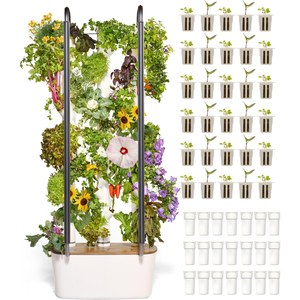
- Plant sites: 30, in three columns
- Size: 24″ W × 12″ D × 64″ H (2 sq. ft.), 20 lb as shipped
- Lights: Two 40W LED bars
- Energy estimate: 47 kWh/month, per Gardyn
- Tank: 5-gallon reservoir (Gardyn help center); refill every 1–2 weeks, per the product page
- Other: Two 5MP cameras, water/humidity/temperature sensors, 2.4 GHz Wi-Fi
Gardyn positions the Home 4 as an indoor garden that can feed a family of four in a two-square-foot footprint. The official price on mygardyn.com, checked November 16, 2026, is $899, and the same model is sold on Amazon by Gardyn Home. A 30-day membership trial is available in the app; membership is not required to grow, but Kelby’s plant-by-plant coaching and the monthly plant credits come with it.
The main tradeoffs are height, cost, and the ecosystem. You need a stable spot and, Gardyn says, wall straps. You also need to be comfortable either paying for membership or buying yCubes and plant food on your own. See our full Gardyn review and the cost breakdown.
Pros
- 30 plants in two square feet
- Company energy figure makes the power bill easy to estimate
- Works without a membership, with fewer app features
Cons
- High purchase price and optional $39/month membership
- 64 inches tall; 2.4 GHz Wi-Fi only
- Not for outdoor use
2. AeroGarden Harvest
Best compact countertop starter
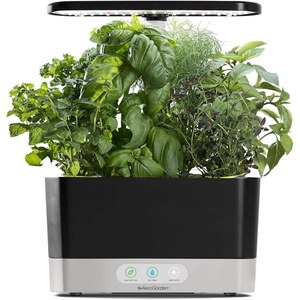
- Plant sites: 6 pods, plants up to 12 inches tall
- Size: 10.5″ L × 6″ W × 17.4″ H; 5.2 lb
- Lights: 20W full-spectrum LED with an automatic timer
- Included: Seed pod kit, 3 oz liquid plant food, power adapter
The Harvest is the straightforward way to see whether you will actually use an indoor garden. It is a hydroponic water-bowl system with a low hood, a simple control panel, and no app requirement. That also sets its limit: 12 inches of grow height is enough for herbs and many greens, not for tall fruiting plants.
If you later want more height, dimmable light, and vacation mode, AeroGarden’s Bounty line is the step up. We compare the hydroponic approach with Click & Grow in AeroGarden vs. Click & Grow.
Pros
- Small footprint and simple controls
- True hydroponic system with liquid nutrients
- Easy first system for herbs and lettuce
Cons
- Only six plants and 12 inches of height
- Pump and tank need periodic cleaning
- You add liquid plant food yourself
3. LetPot LPH-SE 12-Pod
Best mid-size app-controlled countertop
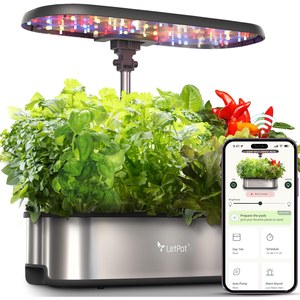
- Plant sites: 12 pods
- Lights: 24W full-spectrum LED, arm adjustable up to 30 inches
- Tank: 5.5 liters, up to about three weeks between refills, per LetPot
- Controls: LetPot app and Wi-Fi, plus on-unit controls
- Size / weight: 16″ × 7″ × 9.8″ body, 5.41 lb, per LetPot’s comparison chart
The LPH-SE sits between a six-pod mini garden and a floor-standing tower. Twelve sites and a 30-inch light arm give you more room to grow greens than a low hood, and the app lets you set a 0-to-24-hour light schedule. It is a pumped hydroponic system, so you will still add nutrients and clean the tank.
Choose it if you want more plants than a Harvest without giving up a slice of floor space to a 5-foot tower.
Pros
- 12 plants and a taller light arm
- App scheduling for the lights
- Larger tank than most mini gardens
Cons
- Needs Wi-Fi if you want the app features
- Uses brand baskets and sponges
- Not a vertical “set it in the corner” tower
Where to Go Next
If you already know you want a compact countertop garden, start with the best hydroponic indoor garden guide and the AeroGarden vs. Click & Grow comparison. If you are considering a tall indoor tower, read the Gardyn review, then the cost analysis and the Lettuce Grow comparison before you buy.
A direct buying link on Gardyn’s or Click & Grow’s own site can sometimes pay a publisher more than an Amazon link. We have not joined those programs. Until that is approved, the product links in this section go to Amazon with our Associates tag.
Frequently Asked Questions
Do I need sunlight for an indoor hydroponic garden?
No. These units are built around a grow light so they can run in a room without a strong window. Minnesota Extension says artificial lighting helps indoor plants grow faster and is especially important in winter. You still want a spot with a stable room temperature and a nearby outlet.
Is hydroponic produce safe to eat?
Yes, when you use food-safe equipment and keep the system clean. Use a tank and fittings made for this purpose, follow the nutrient label, and wash harvested leaves as you would garden lettuce. Clean the reservoir on the schedule the manufacturer recommends so algae and old roots do not build up.
How much electricity does an indoor garden use?
It depends on the lights. Click & Grow lists 6.2 kWh a month for the Smart Garden 9 (about $1.13 at the EIA 2026 year-to-date average of 18.19 cents per kWh). Gardyn lists 47 kWh a month for the Home 4 (about $8.55). A 20-watt lamp that runs 15 hours a day uses about 9 kWh a month. Check your utility rate for a personal figure.
What is the easiest crop to grow first?
Leafy greens and basil. They germinate quickly, stay relatively short, and can be harvested a few leaves at a time. Save compact tomatoes and peppers for a taller system once you are used to keeping the tank filled and the light on a consistent schedule.
Can I use my own seeds?
Often yes, with a seedless pod, a reusable sponge, or a rockwool cube, depending on the brand. Gardyn sells seedless yCubes for this. Click & Grow offers experimental seedless pods. Germination and size still have to match the unit’s height and light, so start with compact herbs and greens.
Related Guides
- Best Hydroponic Indoor Gardens Compared
- Gardyn Home 4 Review
- Is a Gardyn Worth It?
- Gardyn vs. Lettuce Grow
- AeroGarden vs. Click & Grow
- Best Soil for an Herb Garden
- Plant Food vs. Fertilizer
The Gardener’s Voice Team publishes practical gardening guides and product comparisons for home gardeners. We explain how tools, soil, watering systems, and lawn equipment work, and we show our sources when we cite a figure or a recommendation.