Table of Contents
Updated November 2026. As an Amazon Associate we earn from qualifying purchases.
This guide is based on manufacturer specifications and published sources, not a hands-on test of every system in our garden. Where a figure comes from a company, we say so.
Quick Answer: Gardyn or Lettuce Grow?
Choose the Gardyn Home 4 if you want an indoor-only tower with a tight two-square-foot footprint, cameras and app coaching, and plants that start as seed cubes. It holds 30 plants, stands 64 inches tall, and is $899 on mygardyn.com (checked November 16, 2026).
Choose a Lettuce Grow Original Farmstand if you want a tower that can live on a patio in the sun and come indoors with Glow Rings, and if you prefer live seedlings you can harvest in about three weeks. Outdoor Farmstands start at $699. Glow Rings, which the indoor version includes and outdoor owners can add later, start at $399 for the 18-plant size and $499 for the 24-plant size on lettucegrow.com. The Farmstand also needs more floor space: about four square feet and a 22-inch diameter.
Both are vertical hydroponic gardens aimed at people who want more than a six-pod countertop unit. They are not interchangeable. One is a Wi-Fi indoor appliance. The other is a modular stand designed around sunlight first, with lights as an add-on or an indoor bundle. For Gardyn’s specs and costs, see our Home 4 review and Is a Gardyn worth it?. For how towers fit among other indoor gardens, see the indoor hydroponics hub.
Side-by-Side Specs
Figures below come from each company’s official product and help pages, checked November 16, 2026. Indoor Farmstand heights are slightly taller than the outdoor figures because of the Glow Rings.
| Gardyn Home 4 | Lettuce Grow Original Farmstand | |
|---|---|---|
| Where it is designed to live | Indoor only | Outdoor in sun, or indoor with Glow Rings |
| How plants start | Seeded yCubes (rockwool in a compostable shell) | Live seedlings, 2–3 weeks old |
| Plant sites | 30 | 18 (small), 24 (medium), or 36 (large) |
| Footprint | 2 sq. ft. (24″ × 12″) | About 4 sq. ft.; 22″ diameter |
| Height | 64″ | Outdoor: 4’3″, 4’10”, or 6’1″. Indoor with rings: 4’6″, 5’2″, or 6’7″ |
| Tank | 5 gallons (help center) | 20 gallons |
| Lights | Two 40W LED bars, built in | Glow Rings, 96W; not needed outdoors with 6+ hours of sun |
| Energy (published) | 47 kWh/month | Not published as a monthly kWh figure; 96W lamps plus a pump |
| App | Gardyn app; Kelby coaching is a membership feature | Free app with harvest alerts and tips |
| Wi-Fi | Required for the app; 2.4 GHz only | Used for the smart timer; one owner note is that the timer wants 2.4 GHz |
| Ongoing plants | Membership credits or a la carte yCubes from $4.99 | Starter plants from $29.99 for six |
| Hardware price (official) | $899 | Outdoor from $699; Glow Rings kits from $399 / $499 |
| Warranty | 3 years (Gardyn product page) | 3 years, plus a 90-day money-back guarantee |
Indoor Appliance vs. Patio Tower
This is the decision that should come first, before plant counts or cameras.
Gardyn is built for a room. It does not need sunlight or a water line. The lights are part of the frame. You pick a corner with an outlet and 2.4 GHz Wi-Fi, strap the 64-inch unit to the wall, and leave it there. It will not become a backyard garden in June.
A Farmstand is built for light you already have. Lettuce Grow says it performs best outdoors with six or more hours of full sun, in temperatures from 40–100°F, and that you can move it inside and use Glow Rings in the off season. The indoor configuration includes those rings; the outdoor configuration can add them later. That flexibility is the product. It also means more moving parts in your life: a 20-gallon tank, a GFCI outlet, and, indoors, a mat or drip tray because the company warns that filling and aggressive roots can drip on a floor.
If you have no outdoor space and no interest in rolling a 22-inch tower around, Gardyn is the cleaner match. If a sunny patio is the whole point, and indoor lights are the winter backup, Lettuce Grow is the cleaner match.
Seeds and Cameras vs. Live Plants and a pH Kit
Gardyn starts you at day one of germination. Sprouts show in a matter of days, and the first real harvests take longer, which is normal for seed-grown greens. The tradeoff is automation: cameras, sensors, and, with membership, Kelby alerts and a vacation mode. You still refill the tank and add plant food, but you are not asked to be a water-chemistry hobbyist on day one.
Lettuce Grow starts you at week two or three. The company grows the seedlings, ships them live, and says you can harvest in about three weeks, or “2x faster” than starting from seed. You snap plants into the ports and go. The included kit is more old-school hydroponic: nutrients, a smart timer, and a pH test kit. Official care time is about 15 minutes a week to top off water, add nutrients, and check pH, plus a water reset and cleaning about every three months (about 30 minutes). Plants generally stay on the stand for six to eight weeks.
Neither approach is “easier” for everyone. If you want an app to tell you what to do, Gardyn leans that way. If you want a head start on harvest and you do not mind testing pH, Lettuce Grow leans that way. If you dislike both subscriptions and pH kits, this category may not be your favorite — though Gardyn can be run without a membership, and Lettuce Grow’s app is free.
Space, Water, and Power
Gardyn wins on indoor floor space: two square feet versus about four, and a 12-inch depth that is easier to tuck against a wall than a 22-inch circle. It loses on height flexibility only in the sense that 64 inches is fixed; the Farmstand comes in three sizes, including a small 18-plant model that is shorter.
The tanks are very different. A 5-gallon Gardyn tank is lighter and, per the product page, wants a refill every one to two weeks. A 20-gallon Farmstand tank is heavier when full, holds more nutrient solution, and is part of why the stand can sit outdoors through a wider day-to-night swing. Filling 20 gallons indoors is a choreography problem (hose, buckets, spills) that a 5-gallon lid compartment does not present in the same way.
On electricity, Gardyn is easier to budget because it publishes 47 kilowatt-hours a month, or about $8.55 at the EIA average residential rate of 18.19 cents per kilowatt-hour (2026 year-to-date through August). Lettuce Grow does not publish a monthly kilowatt-hour figure for an indoor Farmstand. It does say Glow Rings draw 96 watts, and its assembly guide recommends 14 hours on for two to four rings, 15 hours for five, and 17 hours for six. A 96-watt lamp running 14 hours a day uses about 40.3 kilowatt-hours a month, or about $7.33 at the same EIA rate, before the water pump. Outdoors in season, you may run only the pump, which is the Farmstand’s efficiency advantage when the sun is doing the lighting.
What You Pay After the Hardware
Gardyn’s plant pipeline is membership or a la carte yCubes. Month-to-month Home membership is $39 for 10 credits; without it, cubes start at $4.99 plus $9.99 shipping. That model is discussed in detail in Is a Gardyn worth it?.
Lettuce Grow charges for living plants, starting at $29.99 for six starters. That is a higher cost per plant than a member-priced yCube, but you are buying a seedling that has already been grown out, not a seed. The Farmstand hardware includes a first set of starter plants (the medium configuration is described as including 24 live plants or redeemable credits). There is no Gardyn-style monthly membership required to keep using the stand, which some buyers will count as a plus.
Warranty terms are similar on paper: three years for both, with Lettuce Grow also advertising a 90-day money-back guarantee on Farmstand orders. Glow Rings have their own 90-day return window.
Who Should Buy Which
Buy a Gardyn Home 4 if your garden will live indoors year-round, you want the smaller footprint, and you like the idea of cameras and a guided app (whether or not you keep paying for Kelby). It is also the better pick if a 5-gallon tank is as much water as you want to carry.
Buy a Lettuce Grow Farmstand if you have sun for at least part of the year, you want to start with live plants, and you are comfortable with a larger footprint and periodic pH checks. Pick the size from how many people you are feeding: 18 plants for one or two people, 24 as the company’s “most versatile” size, 36 for a larger household.
If you only need herbs on a counter, buy neither of these first. A six-pod AeroGarden Harvest or a 12-pod LetPot will answer the “do I harvest what I grow?” question at a much lower price. Come back to a tower when you have outgrown the counter.
Lettuce Grow is sold on its own site, so there is no Amazon product box for the Farmstand on this page. If we later join a Lettuce Grow or Gardyn direct affiliate program, those links would likely earn more than an Amazon link. That has not been approved, so the Gardyn button below is an Amazon Associates link, and we point you to lettucegrow.com for the Farmstand.
1. Gardyn Home 4
Best indoor-only 30-plant tower
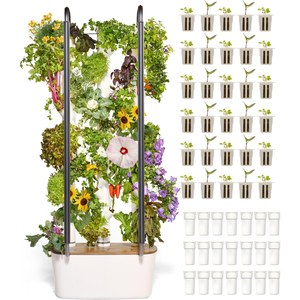
- Plant sites: 30
- Size: 24″ W × 12″ D × 64″ H, 2 sq. ft.
- Lights / energy: Two 40W LEDs; 47 kWh/month, per Gardyn
- Tank: 5 gallons
- Official price: $899, checked November 16, 2026
This is the tower to compare with a Farmstand if your space is a living room or kitchen corner and you want the plant count of a vertical garden without a 20-gallon patio tank.
Pros
- Smaller indoor footprint and built-in lights
- Optional AI monitoring and a published energy figure
- Starts from seed cubes, with a sprout guarantee
Cons
- Indoor only; 2.4 GHz Wi-Fi and wall straps required
- Membership is how you get cheap plants and full app features
- First harvest is slower than a live-seedling system
Frequently Asked Questions
Which grows more plants, Gardyn or Lettuce Grow?
The Gardyn Home holds 30. A Farmstand holds 18, 24, or 36, depending on size. The large Farmstand can exceed Gardyn’s plant count, but it also needs about four square feet and more height with Glow Rings installed.
Can I use a Gardyn outdoors?
No. Gardyn specifies indoor use. If you want a tower for a patio, the Farmstand is built for that, with an optional move indoors under Glow Rings.
Which is cheaper to buy?
An outdoor Farmstand starts at $699, which is less than the $899 Gardyn Home 4. An indoor Farmstand also needs Glow Rings, which start at $399 or $499 if you buy them separately. Add those pieces together before you call either one cheaper. Running costs then diverge: Gardyn membership or a la carte yCubes versus Lettuce Grow’s live plant packs.
Which is easier for a beginner?
It depends on what you find easy. Gardyn hides more of the water chemistry and, with membership, tells you what to do in the app. Lettuce Grow skips germination by shipping live plants but asks you to test pH and tend a larger tank. Neither is as simple as a six-pod countertop garden.
Do I have to pay a membership for Lettuce Grow?
No monthly membership is required to operate a Farmstand. You buy starter plants as you need them, starting at $29.99 for six, and the companion app is free. Gardyn’s hardware also works without membership, but its cheaper plant prices and Kelby features are on a paid plan.
Related Guides
- Gardyn Home 4 Review
- Is a Gardyn Worth It?
- Best Hydroponic Indoor Gardens Compared
- Indoor Hydroponic Gardens Guide
- AeroGarden vs. Click & Grow
The Gardener’s Voice Team publishes practical gardening guides and product comparisons for home gardeners. We explain how tools, soil, watering systems, and lawn equipment work, and we show our sources when we cite a figure or a recommendation.